Hawaiʻi Supreme Court Brings Oral Argument to more than 400 Students at Punahou School
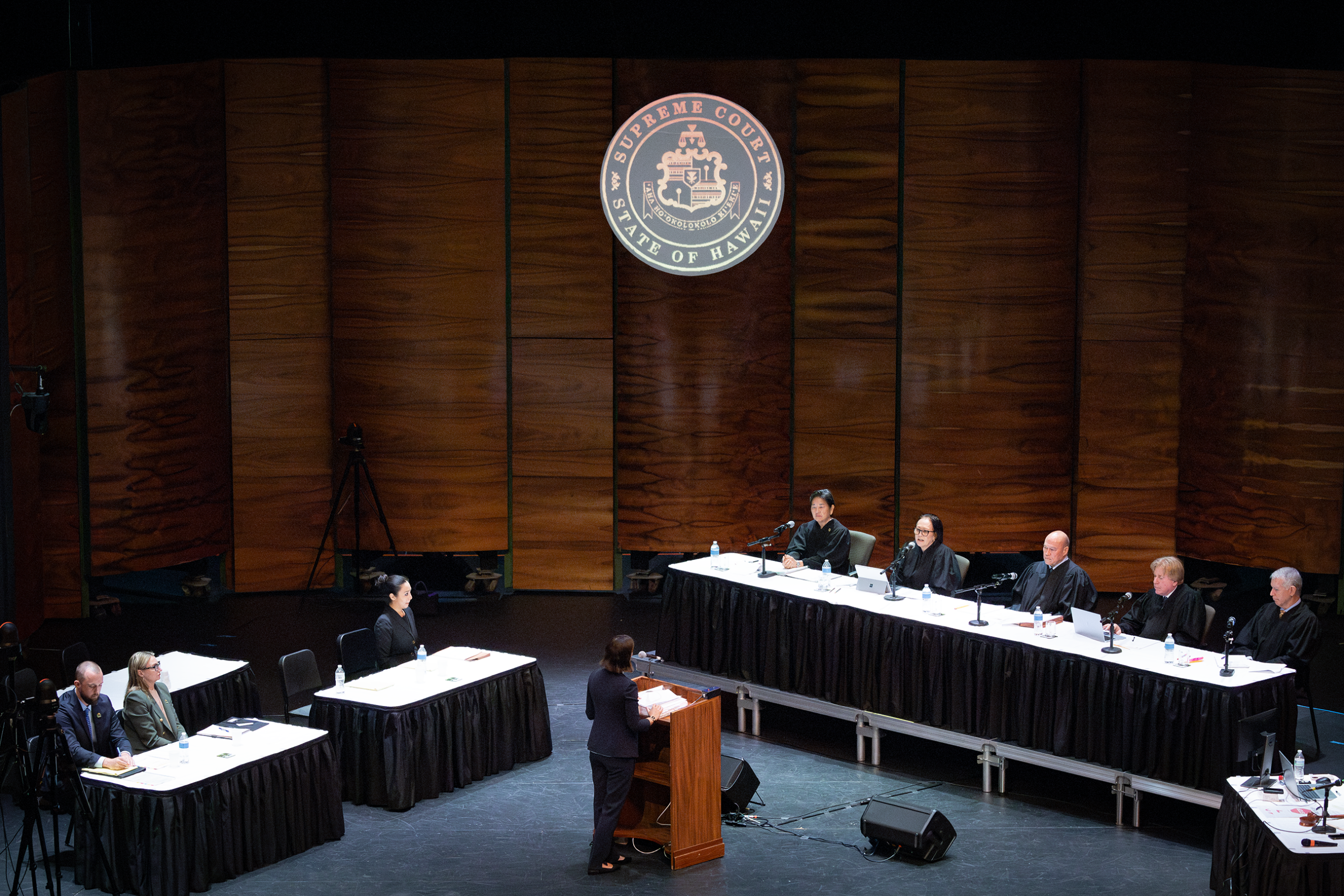
HONOLULU, Hawaiʻi – On Monday, November 9, 2026, the Hawaiʻi Supreme Court convened in Dillingham Hall at Punahou School rather than at Aliʻiōlani Hale. There, 433 students from 11 Oʻahu schools observed the justices hear oral argument in a pending case.
The session was part of the Hawaiʻi State Judiciary's Courts in the Community program, which brings the state's highest court to schools so students can see how appellate courts operate.
The Case
Nonhuman Rights Project v. City and County of Honolulu asks whether Mari and Vaigai, the Honolulu Zoo's two elephants, can petition for a writ of habeas corpus. Habeas corpus is the legal process traditionally used to challenge the lawfulness of a person's confinement. The lower courts dismissed the petition.
The Nonhuman Rights Project
Argued that the elephants are autonomous beings with an interest in liberty that the common law should protect.
The City and County of Honolulu
Argued that habeas corpus applies only to human beings and that any change of this magnitude should come from the Legislature.
Learning Before, During and After
Students studied the case in their classrooms before the hearing. Volunteer attorneys visited the participating schools to walk through the legal issues, and students worked through the arguments during mock proceedings.
On the day of the argument, the justices questioned both sides about where to draw the line, how to weigh Hawaiian cultural values, and whether the question belongs to the courts or the Legislature. For many students, it was their first court proceeding.
"Change is possible, change happens."
Aletheia Uchida, Punahou senior, speaking to The New York Times about watching the argument in person
After the oral argument, students participated in two separate question-and-answer sessions: one with the attorneys who argued the case and another with the justices.
Mahalo
Mahalo to the Hawaiʻi State Judiciary, the King Kamehameha V Judiciary History Center, the Hawaiʻi State Bar Association, Punahou School and the Davis Democracy Initiative, the William S. Richardson School of Law, the volunteer attorneys, and the teachers and students of all 11 participating schools.
About PACE
The Commission to Promote and Advance Civic Education (PACE) was established by the Hawaiʻi Supreme Court in 2021. The nonpartisan commission works with schools, courts, and community partners across the state to strengthen civic learning for Hawaiʻi's students and residents.