The Hawaiʻi State Constitution, Amendments & Federalism
Every person in Hawaiʻi lives under two constitutions at once. Here’s what Hawaiʻi’s constitution is, how it can be changed, and how federalism divides authority between Hawaiʻi and the federal government.
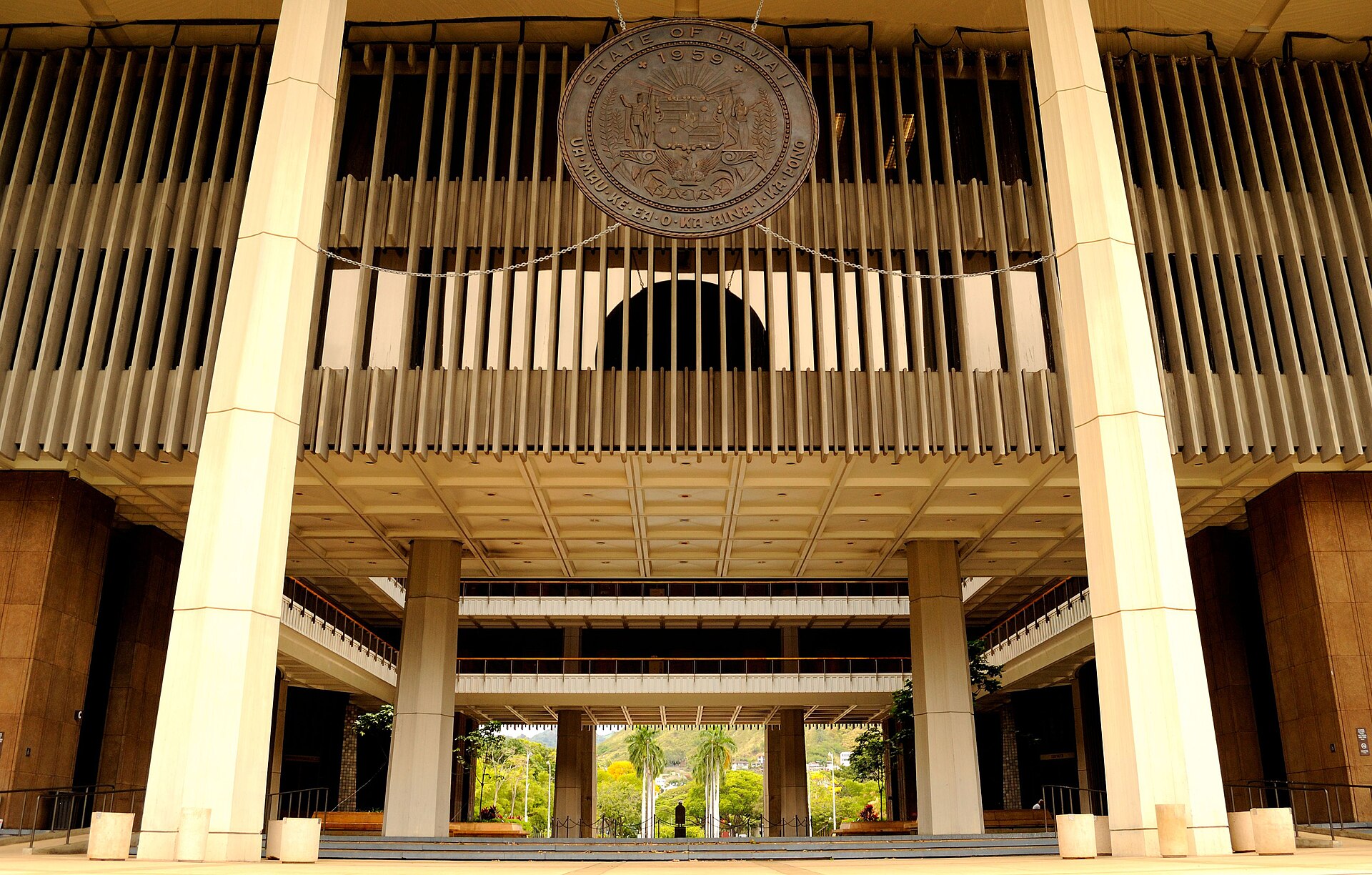 Hawaiʻi State Capitol
Before Statehood: Hawaiʻi’s Earlier Constitutions, 1840–1900
Hawaiʻi’s constitutional tradition did not begin in 1950. For most of the 19th century, the Hawaiian Kingdom was an independent, internationally recognized constitutional monarchy with its own succession of governing charters. That history includes four Kingdom constitutions, one constitution proposed but never enacted, a transitional Provisional Government, a Republic, and eventually a U.S. territorial government — each marking a major shift in who held power and whose rights were protected.
King Kamehameha III enacted the Hawaiian Kingdom’s first written constitution on October 8, 1840, building on the 1839 Declaration of Rights. It established a constitutional monarchy with executive, legislative, and judicial branches, created a House of Representatives, and set out rights for Hawaiian subjects.
Kamehameha III signed a revised and expanded constitution, published in both Hawaiian and English, that further limited royal authority and broadened voting rights.
Kamehameha V refused to take an oath to the 1852 constitution and called a convention. When delegates reached an impasse, he dissolved it and promulgated his own constitution on August 20, 1864 — increasing the monarch’s power, merging the House of Nobles and House of Representatives into a single legislature, and adding property requirements for voters.
An armed militia tied to a group of businessmen and lawyers known as the Hawaiian League forced King Kalākaua to sign a new constitution on July 6, 1887. It sharply reduced royal authority, shifted power to the legislature and cabinet, and rewrote voting qualifications — extending the vote to non-citizen resident foreigners who met income and property tests while imposing requirements that excluded most Native Hawaiians and stripped voting rights from Asian residents entirely.
Responding to thousands of petitions from Native Hawaiians, Queen Liliʻuokalani drafted a new constitution intended to lower property requirements for voting, restore greater authority to the monarchy, and remove voting rights the 1887 constitution had extended to non-citizen residents. She planned to proclaim it on January 14, 1893, but her cabinet ministers withheld their support and she did not proceed. A group opposed to the monarchy cited her attempt as grounds to act: with the support of U.S. Minister John L. Stevens and armed U.S. Marines landed from the USS Boston, they declared the monarchy overthrown on January 17, 1893. The proposed constitution itself was never enacted.
A Committee of Safety proclaimed a Provisional Government immediately after the overthrow, led by Sanford B. Dole, intended as a transitional authority pending an anticipated annexation to the United States. It kept most existing Hawaiian laws in force except where they conflicted with its own authority.
When annexation did not happen right away, the Provisional Government convened a constitutional convention of appointed and elected delegates. The resulting constitution was signed July 3 and promulgated July 4, 1894, establishing the Republic of Hawaiʻi with Dole as President. It required voters to swear allegiance to the new government and meet income, property, and nativity requirements that excluded much of the Native Hawaiian population.
Congress annexed Hawaiʻi to the United States through the Newlands Resolution, a joint resolution rather than a treaty. The formal transfer of sovereignty took place on August 12, 1898.
The Hawaiian Organic Act established the Territory of Hawaiʻi, extended the U.S. Constitution to the islands, and took effect June 14, 1900. It created an appointed governor, an elected bicameral territorial legislature, U.S. citizenship for residents, and one non-voting delegate to the U.S. House of Representatives — the territorial government that governed until statehood in 1959.
In 1993, on the 100th anniversary of the overthrow, Congress passed a joint resolution — Public Law 103-150, commonly called the Apology Resolution — acknowledging that the overthrow of the Kingdom of Hawaiʻi occurred with the participation of U.S. diplomatic and military representatives and that Native Hawaiians never directly relinquished their claims to sovereignty over their national lands. The resolution states it does not itself settle any legal claims. This history is part of why Native Hawaiian rights hold a distinct place in Hawaiʻi’s current constitution, discussed further below.
What Is the Hawaiʻi State Constitution?
The Constitution of the State of Hawaiʻi is the foundational legal document for state government. It establishes the three branches of state government (legislative, executive, and judicial), lays out a state Bill of Rights, and sets the rules by which Hawaiʻi governs itself — everything from elections and taxation to education and Hawaiian affairs.
“We, the people of Hawaii, grateful for Divine Guidance, and mindful of our Hawaiian heritage and uniqueness as an island State, dedicate our efforts to fulfill the philosophy decreed by the Hawaii State motto, ‘Ua mau ke ea o ka aina i ka pono.'”
— Preamble, Constitution of the State of HawaiʻiA Brief History
A constitutional convention of 63 elected delegates drafted Hawaiʻi’s constitution in preparation for statehood. Voters adopted it on November 7, 1950.
Ahead of statehood, Congress required three changes to the 1950 document. Voters approved them on June 27, 1959, and the constitution took effect August 21, 1959, when Hawaiʻi was admitted as the 50th state.
Hawaiʻi’s second constitutional convention proposed amendments that voters later approved.
102 delegates produced 34 amendments — the largest single revision in the constitution’s history. This convention created the Office of Hawaiian Affairs, made Hawaiian an official state language, and added the state’s explicit right to privacy and environmental rights.
Hawaiʻi has held three constitutional conventions since 1950 (1950, 1968, and 1978) — but the document has been amended far more often than that. Most changes come through amendments the legislature refers directly to voters.
 1978 Constitutional Convention
Photo: University of Hawaiʻi.
How Is the Constitution Amended?
Article XVII of the Hawaiʻi Constitution lays out two ways to propose a change — and in both cases, the final decision belongs to Hawaiʻi’s voters.
Legislative Proposal
Art. XVII, §3- The legislature passes a proposed amendment by a two-thirds vote in both chambers in one session, or a simple majority vote in two successive sessions.
- The proposal is published and placed on the ballot at the next general election.
- Voters approve or reject it directly. The Governor has no veto power over constitutional amendments (Art. XVII, §4).
Constitutional Convention
Art. XVII, §2- The legislature can put the question “Shall there be a convention…?” on the ballot.
- If nine years pass without that question being placed on the ballot, it appears automatically at the next general election.
- If voters say yes, delegates are elected, the convention drafts changes, and voters give final approval.
What It Takes to Pass Art. XVII, §2
Under either path, a proposed amendment becomes part of the constitution only if approved by a majority of the votes cast on that specific question — and that majority must equal at least 50% of the total votes cast in the election (or, for a special election, at least 30% of all registered voters). Leaving the question blank on a ballot effectively counts as a “no.”
The constitutional convention question was last on the ballot in 2018, when voters rejected it by a wide margin. Under the nine-year rule, it is scheduled to return automatically in 2028.
Federalism: The Floor, Not the Ceiling
Federalism is the system that divides governing power between the national government and the states. The U.S. Constitution grants the federal government specific, enumerated powers — national defense, currency, foreign affairs, interstate commerce. Everything not granted to the federal government, and not prohibited to the states, is reserved to the states or the people. In Hawaiʻi, that reserved authority — over things like education, land use, family law, and elections administration — is what the Hawaiʻi Constitution and state legislature govern.
Where federal law and state law genuinely conflict, the U.S. Constitution’s Supremacy Clause (Article VI) means federal law controls. But that principle is often misunderstood — it does not mean the federal government sets the only rules that matter. It means the U.S. Constitution sets a floor, not a ceiling.
What “Floor, Not Ceiling” Means
The rights guaranteed in the U.S. Constitution are the minimum every person is entitled to, no matter which state they live in. No state may offer its residents less. But states are free to guarantee more through their own constitutions — and Hawaiʻi does, in several notable ways.
Hawaiʻi’s constitution explicitly states, “The right of the people to privacy is recognized and shall not be infringed without the showing of a compelling state interest.” The U.S. Constitution contains no equivalent explicit privacy right.
Hawaiʻi residents have a constitutional right to a clean and healthful environment. There is no federal constitutional equivalent.
Hawaiʻi’s constitution extends this right to both private- and public-sector employees. Federal labor law generally does not cover public-sector workers at all.
Hawaiʻi’s constitution requires the state to provide free public education. The U.S. Constitution does not mention education.
Hawaiʻi’s constitution protects traditional and customary rights of Native Hawaiians, subject to the state’s regulatory power. There is no federal constitutional counterpart.
Hawaiʻi’s state courts — District, Circuit, the Intermediate Court of Appeals, and the Hawaiʻi Supreme Court — interpret and apply the Hawaiʻi Constitution and state law. The U.S. District Court for the District of Hawaiʻi and federal appellate courts interpret and apply the U.S. Constitution and federal law. Both systems operate side by side, each with its own jurisdiction.
Side by Side: Hawaiʻi vs. U.S. Amendment Process
Comparing how each constitution gets amended is one of the clearest ways to see federalism in action — two governments, operating under different rules, both ultimately answerable to “We the People.”
| Hawaiʻi Constitution | U.S. Constitution | |
|---|---|---|
| How it’s proposed | Legislature (2/3 vote in one session, or majority vote in two successive sessions) — or a constitutional convention | Congress (2/3 vote of both chambers) — or a convention called by 2/3 of state legislatures |
| Convention option used? | Yes — held in 1950, 1968, and 1978 | Never used in U.S. history |
| How it’s ratified | Direct vote of the people at a general or special election | Three-fourths of state legislatures, or state ratifying conventions (used once, for the 21st Amendment) |
| Executive veto? | No — the Governor cannot veto a proposed amendment | No — the President has no constitutional role in the process |
| Direct popular vote? | Yes — every Hawaiʻi amendment requires voters to approve it at the ballot box | No — the federal process is never put directly to a nationwide popular vote |
Hawaiʻi’s amendment process runs through direct democracy: voters decide every single change to their state constitution. The federal process runs entirely through representative bodies — Congress and state legislatures or conventions — and has never once asked voters nationwide to weigh in directly.
Key Terms
Federalism
A system of government where power is divided between a national government and regional (state) governments.
Amendment
A formal change to the text of a constitution.
Constitutional Convention
A gathering of elected delegates convened to propose revisions or amendments to a constitution.
Ratification
The formal act of approving a proposed amendment, making it legally effective.
Supremacy Clause
Article VI of the U.S. Constitution — federal law prevails when it genuinely conflicts with state law.
Reserved Powers
Powers not granted to the federal government and not prohibited to the states, belonging to the states or the people.
Enumerated Powers
Powers specifically granted to the federal government by the U.S. Constitution.
Legislatively Referred Amendment
An amendment proposed by the legislature and sent to voters, rather than through a convention.
Sources & Further Reading
- United States Constitution — National Archives
- The Declaration of Independence — National Archives
- America’s Founding Documents — National Archives
- Hawaiʻi Constitution — Legislative Reference Bureau
- Hawaiʻi Constitutional Convention Studies, 1978 — Legislative Reference Bureau
- The Past’s Plan for Hawaiʻi’s Future: The 1978 Constitutional Convention in Context
- Evolving Hawaiʻi Constitution — Three-Part Series (1950–1978, 1978, 1979–2025), HIPA
- Comparative Constitutions — Constitute Project
- Comparative Constitutions — Comparative Constitutions Project
- PBS Hawaiʻi Classics: 1978 Constitutional Convention (7/8/1978)
- PBS Hawaiʻi Classics: Hawaiʻi Report, 1968 Constitutional Convention — Part 1
- PBS Hawaiʻi Classics: Hawaiʻi Report, 1968 Constitutional Convention — Part 2
- 1894 Constitutional Convention — Hawaiʻi State Archives
- Organic Act of 1900 — official text, Hawaiʻi Revised Statutes
- Public Law 103-150, the Apology Resolution (1993) — Congress.gov
A Nonpartisan Resource
This page is provided by the Hawaiʻi Commission to Promote and Advance Civic Education (PACE). It describes constitutional structure and process only, and does not take a position on any pending or future ballot question.